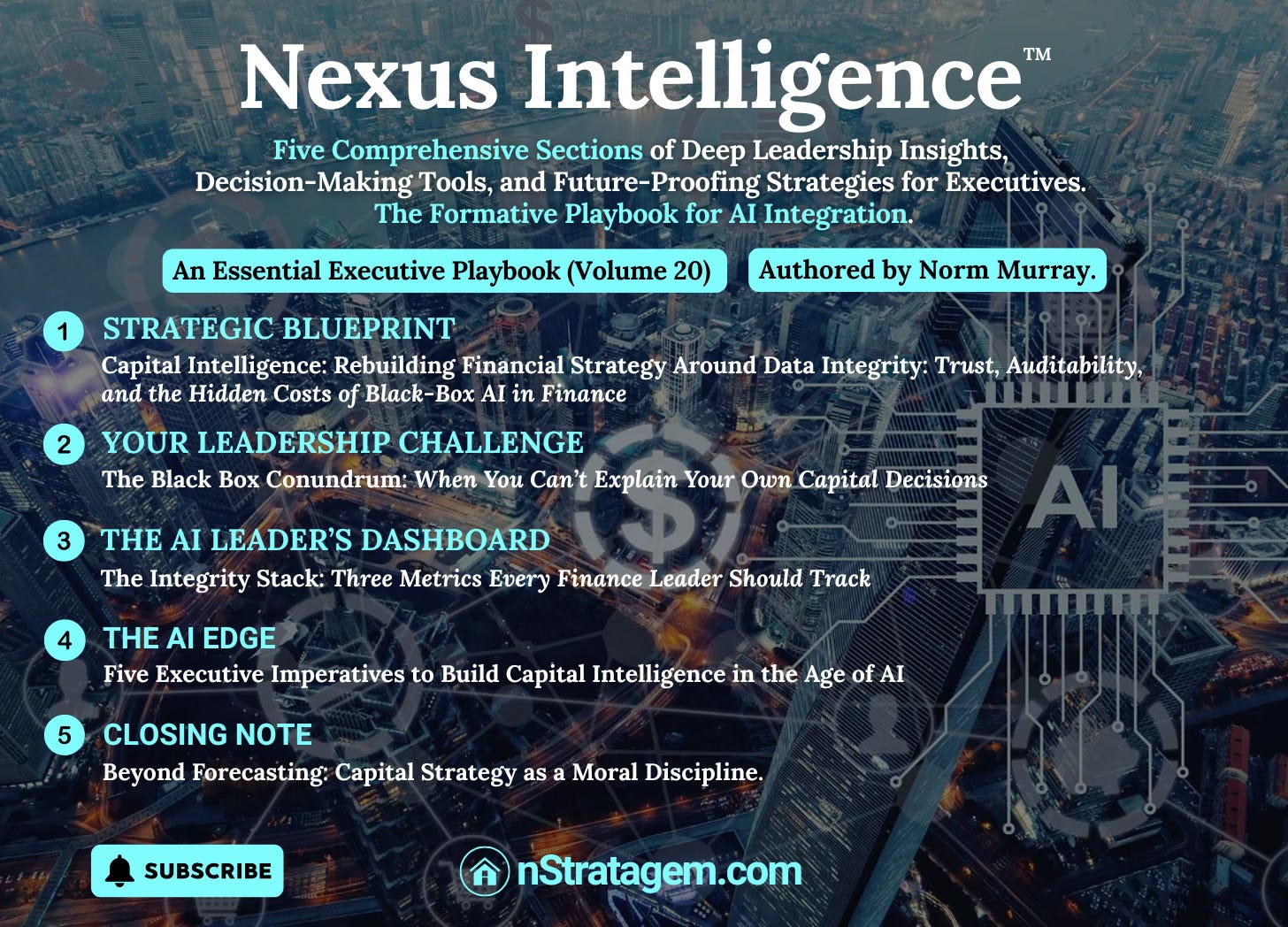
20. Capital Intelligence: Rebuilding Financial Strategy Around Data Integrity.
Trust, Auditability, and the Hidden Costs of Black-Box AI in Finance



$ The global financial architecture is in the midst of a profound epistemological shift, one that is changing not only how capital is managed but how knowledge, authority, and judgment are distributed within organizations.
For centuries, financial leadership has been grounded in systems of linear logic, structured data, and human-led modeling. Today, however, that foundation is being recalibrated by the advent of algorithmic inference.
Artificial Intelligence is no longer simply augmenting financial processes, it is interpreting economic signals, proposing strategic allocations, and even reshaping organizational priorities. With machine learning and neural networks embedded in everything from credit risk models to M&A strategies, a new reality emerges: capital decisions are increasingly being made, or at least heavily influenced, by systems that few executives truly understand.
This raises a fundamental question that now sits at the heart of every boardroom: What does it mean to lead financial strategy when you cannot fully explain the mechanisms behind your own forecasts?
👉 Let me ask you this:
1. Can you defend your capital strategy in a boardroom, if your AI Model can’t explain its own decisions?
♦️What if the smartest system in your finance stack is also your biggest liability? Discover how to lead when transparency is no longer guaranteed.
2. What happens to fiduciary accountability when the forecast is right, but no on understands why?
♦️In a world of black-box finance, trust is no longer a given. Learn how the new CFO governs not just money, but meaning.